

 Support
 Sign In
 Cart
Cart 
Wind turbines and solar panels are probably the first things that come to mind when folks think about renewable energy. They’re everywhere, but honestly, they couldn’t be more different in how they churn out electricity. Wind turbines can convert anywhere from 60% to 90% of captured wind energy into electricity, while solar panels are usually in the 20% to 25% ballpark for efficiency. If you’re considering clean energy investments—for your own home or a commercial project—getting a grip on these numbers is pretty important.
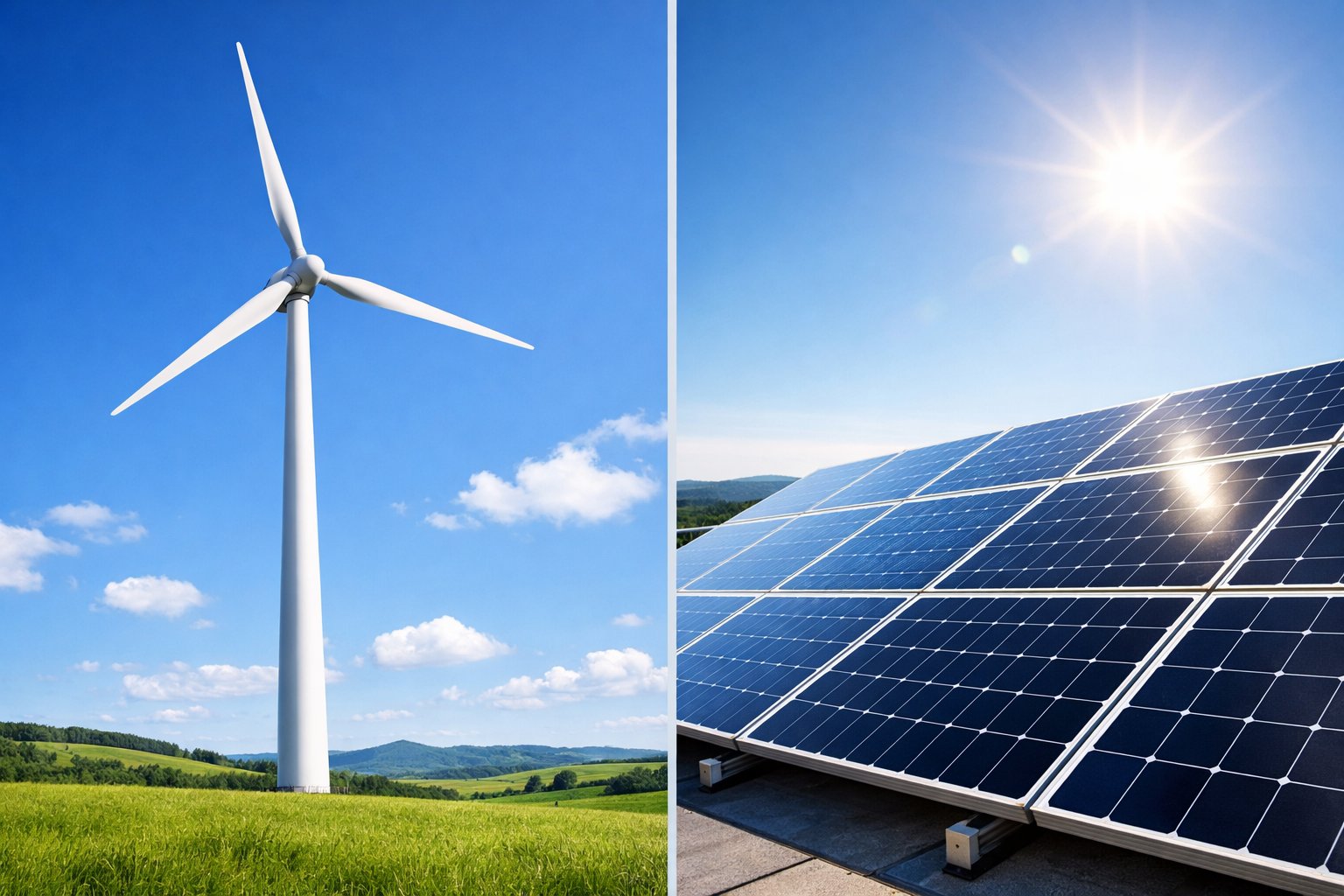
But, let’s not get too hung up on conversion efficiency alone. Real-life energy production? That’s a whole different animal. It’s shaped by where you put the system, the local weather, installation budgets, and how much TLC the equipment needs over its lifetime. As solar engineers, we have to look at the whole picture—how these systems perform in the field, what they cost up front, how much space they need, and how they’ll hold up over decades.
Both wind and solar tech are moving targets—costs keep dropping, and the tech keeps getting better. So, let’s dig into the nuts and bolts that really separate these two.
Energy Production and Efficiency Comparison
Wind turbines can convert 60-90% of the wind’s kinetic energy into electricity, while solar panels only manage 20-25% of sunlight. But those numbers don’t tell the whole story. Real-world production hinges on capacity factors, site conditions, and the physics behind each technology.
How Wind Turbines Generate Electricity
Wind turbines grab kinetic energy with those huge blades—think of them as airfoils, not unlike airplane wings. As wind pushes past, it creates lift and drag, spinning the rotor. That rotational energy travels down the shaft to a generator tucked inside the nacelle.
The generator’s job? Turning all that mechanical spin into electrical current, using electromagnetic induction. Most turbines need a minimum wind speed—about 9 mph—before they’ll even start spinning out power. They really hit their stride at 25-35 mph.
Now, efficiency is all over the map, depending on wind consistency and the turbine’s design. Offshore turbines, for example, tend to outperform land-based ones because ocean winds are just more reliable. Coastal areas get about 45% steadier wind than inland sites, and if you’re in a mountain corridor, you might see wind speeds jump by 50% thanks to natural funneling.
How Solar Panels Convert Sunlight Into Power
Solar panels work via the photovoltaic effect. Sunlight hits the silicon wafers inside each cell, knocking electrons loose and generating direct current (DC) electricity. Each cell doesn’t do much alone, but string a bunch together and you’ve got a panel that can actually power something.
The electrons flow through the wiring and out to your inverter, where DC gets flipped to AC for your home or sent to storage. Most commercial panels these days are hitting 22% energy conversion rates under lab conditions. If you’re lucky enough to install bifacial panels, you can even grab reflected sunlight, which can bump output by up to 30% if the site’s right.
Energy Conversion Rates: Wind Turbine Versus Solar Panel
So, what does this look like side by side?
| Technology | Conversion Efficiency | Energy Input Type |
|---|---|---|
| Wind Turbines | 60-90% | Kinetic wind energy |
| Solar Panels | 20-25% | Solar radiation |
| High-Efficiency Solar | Up to 44% | Solar radiation (perovskite) |
Wind tech comes out ahead on conversion because it’s using mechanical energy directly—less gets lost to heat. Solar, on the other hand, runs up against some hard physical limits. The Shockley-Queisser limit, for example, caps single-junction silicon cells at about 33% efficiency.
Perovskite cells are starting to shake things up. We’re seeing up to 44% efficiency in the lab, and they’re cheaper to make, too—manufacturing costs can drop by 60% compared to traditional silicon.
Capacity Factor and Real-World Output
Capacity factor is where things get interesting. It’s the ratio of actual output to what you’d get if the system ran at full tilt 24/7. Wind turbines, in good locations, can hit 35-45%. Solar typically lands between 15-25%, depending on latitude and cloud cover.
Wind’s big advantage: it can run day or night, as long as the wind’s blowing. Solar’s stuck with daylight—production in summer can be 60% higher than in winter. Clouds can knock solar output down by about 25%.
For a typical home, you’re looking at 16 panels to cover average electricity needs. A standard 7.2 kW system usually does the trick. Wind turbines can outpace solar in total energy produced per install, but only if you’ve got steady wind. No wind, no juice.
Geography is huge here. Latitude can swing your solar harvest by 40% annually. If you’re in the middle of a flat plain, wind turbines can be 35% more productive than in cluttered or hilly terrain.
Cost, Environmental Impact, and Application Scenarios
Solar panels are the clear favorite for residential installs, running $20,000-$30,000 for a typical system. Wind turbines? You’re looking at $50,000-$75,000, so they’re a tougher sell for most homeowners. But up-front cost isn’t the whole story—maintenance, land use, and the right application all matter.
Installation Cost and Maintenance Requirements
Solar install prices have been dropping for years. Residential solar systems now average $2.50-$3.00 per watt installed. So, a 10 kW system will set you back $25,000-$30,000 before tax credits or incentives. Most installs take just a few days—mount the racks, drop the panels, wire it up, and you’re good to go.
Wind turbines are a different beast. For a 10 kW home-scale turbine, you’re shelling out $50,000-$75,000, and the install can drag on for weeks. You need a solid foundation, a tall tower, and a crane just to lift the nacelle. Plus, there’s a pile of paperwork and grid interconnection headaches.
Maintenance? Solar is about as hands-off as it gets. Maybe hose off the panels once in a while, swap the inverter every 10-15 years—budget $150-$300 a year. Wind turbines, with all those moving parts, need regular TLC: gearbox lubrication, blade inspections, and bearing replacements can run $1,000-$3,000 per year.
If you’re crunching numbers, the levelized cost of energy (LCOE) is where the rubber meets the road. Solar utility-scale projects are at $0.03-$0.06 per kWh, onshore wind is $0.02-$0.05, and offshore wind is pricier at $0.08-$0.10. For homes, solar usually wins out just because it’s easier and cheaper to install and maintain.
| Cost Factor | Residential Solar | Residential Wind |
|---|---|---|
| Installation | $20,000-$30,000 | $50,000-$75,000 |
| Annual Maintenance | $150-$300 | $1,000-$3,000 |
| Payback Period | 6-10 years | 8-15 years |
| Lifespan | 25-30 years | 20-25 years |
If you want batteries for backup or to go off-grid, tack on another $10,000-$15,000. Hybrid solar-wind setups are possible, but you’ll pay more up front for the flexibility.
Environmental Impact and Land Use
Both solar and wind are way cleaner than fossil fuels, but neither is totally impact-free. Solar panels have an energy payback of 1-4 years, so after that, they’re generating more energy than was used to make them.
Wind turbines pay back their embodied energy even faster—usually within 6-12 months, thanks to their higher output. But let’s not gloss over the steel and concrete needed for those towers, which means a bigger carbon footprint at the start.
Land use is a bit of a mixed bag. Utility-scale solar needs about 3-4 acres per MW, but rooftop installs don’t use up any new land. Agrivoltaics—where you farm under the panels—is catching on, so you don’t always have to pick between crops and kilowatts. Wind farms need 30-50 acres per MW, but the actual footprint is tiny, so you can still graze cattle or grow crops around the towers.
Wind turbines do have their drawbacks: bird and bat strikes, especially on migration paths, are a real concern. Offshore wind sidesteps some of that, but it can disrupt marine life. And yeah, some folks aren’t wild about the noise—small turbines are in the 40-60 decibel range at a distance.
Solar is quiet and doesn’t mess with wildlife much, but big solar farms can disrupt habitats if not planned carefully. Recycling is getting better—most of the silicon, aluminum, and glass can be recovered. Wind turbine blades, though, are tough to recycle because of all that fiberglass; it’s a problem the industry still hasn’t quite solved.
Best Use Cases and Suitability for Different Locations
Residential solar is honestly a solid fit for most urban and suburban homes, as long as there’s enough roof space and you’re not dealing with a ton of shade from trees or neighboring buildings. If you’re in an area where zoning codes restrict wind turbine height or have tight setback rules, solar’s almost always the go-to. Rooftop arrays and solar shingles are especially popular in neighborhoods where curb appeal matters—nobody wants to be that house with the giant windmill on a small lot.
For commercial projects, solar really shines on sprawling warehouse roofs and commercial buildings with big daytime loads. Large flat roofs are basically begging for PV modules. Solar farms? They’re surprisingly versatile—sure, the Southwest gets the headlines, but even up north, long summer days and cooler temps can boost panel efficiency more than most people expect.
Now, residential wind turbines—that’s a different animal. You’ll need a rural property, at least an acre, and you better hope for consistent wind speeds north of 12 mph. We’ve seen the best results in the Great Plains, certain mountain passes, and coastal stretches where wind is more reliable. To put it in perspective, a well-sited 10 kW wind turbine can crank out 15,000 to 25,000 kWh per year, which is a bit more than you’d get from a similar-sized solar system—assuming the wind actually shows up.
Commercial wind? Farms, big industrial sites, or distribution centers with lots of open land and strong wind profiles are ideal. Offshore wind farms are in a league of their own—those projects tap into powerful, steady winds but they’re not for the faint of heart (or budget), and you’ll need a crew that knows their stuff for installation.
Sizing really comes down to your load profile. If your home eats up 10,000 to 12,000 kWh per year, you’re probably looking at a 7-8 kW solar array or a smaller wind turbine if the winds are good. Net metering rules can change the whole equation, though—some places make it easy to sell excess power back to the grid, others not so much.
Honestly, a professional energy assessment should be your first move. In cities, solar almost always wins out—it’s just quieter, easier to fit, and less hassle with neighbors. But if you’re out in the sticks and the wind is right, turbines or even a hybrid solar-wind setup can give you more consistent output and a bit of redundancy.


