

 Support
 Sign In
 Cart
Cart 
Solar connectors might look like tiny details in the grand scheme of a PV system, but if you’ve ever had to troubleshoot a string fault in the middle of July, you know just how critical they really are. They’re the unsung heroes—those specialized electrical connectors that tie your panels to inverters, optimizers, and everything in between. Getting the right solar connectors isn’t just a box-checking exercise; it’s about matching up electrical specs, weatherproofing, and making sure your gear all plays nicely together. The difference? It can mean years of hassle-free production—or a call-back for a melted connector.
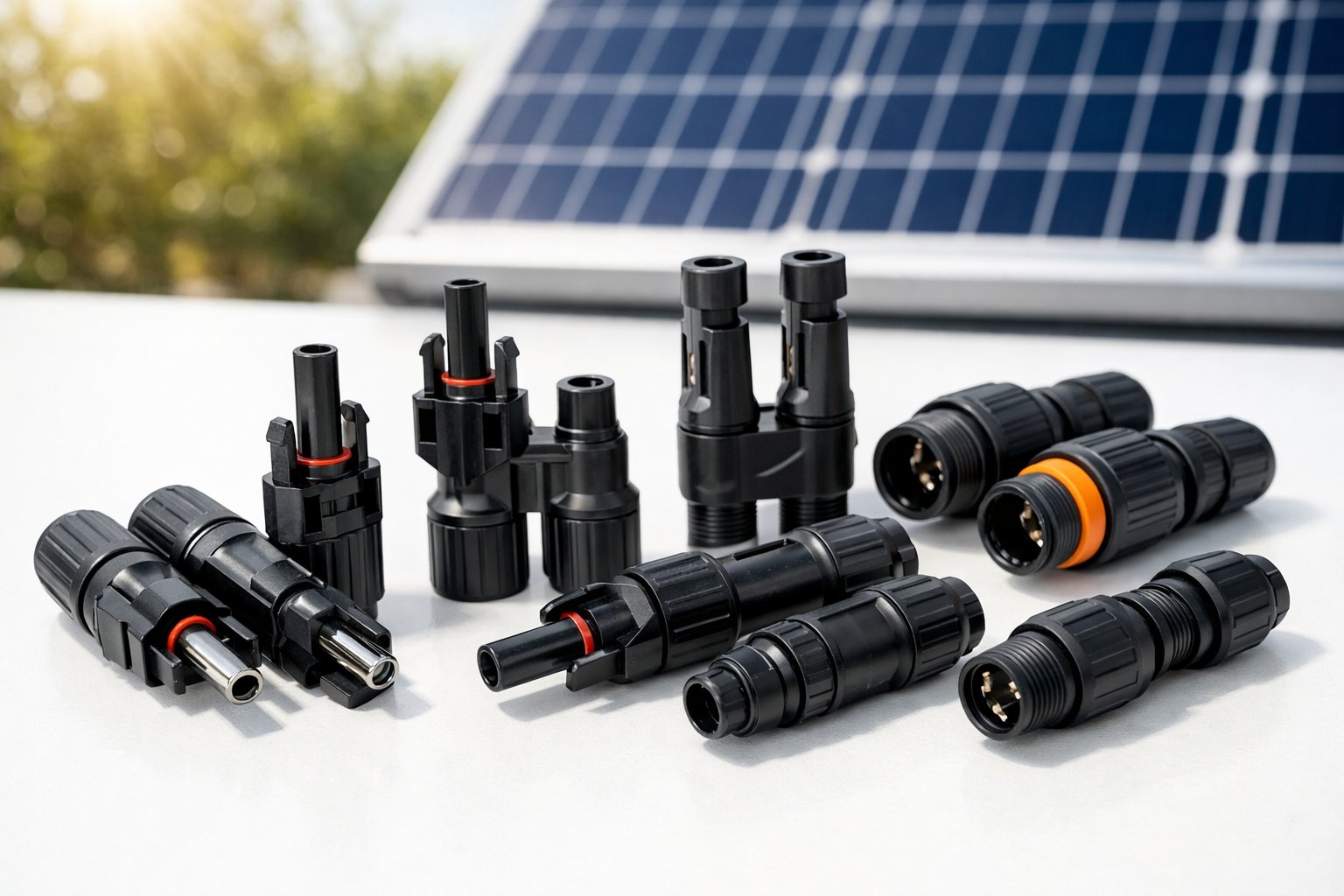
This guide is for anyone knee-deep in a solar install—whether you’re piecing together your own system, adding new panels to an existing array, or just trying to make sense of what your installer’s talking about. If you know your MC4s from your MC3s, great; if not, no worries. We’ll break down the main connector types, the specs that actually matter, and some of the practical stuff that tends to get glossed over. There’s more to connectors than just MC4s—though let’s be honest, they dominate the market. There are also specialized alternatives for niche jobs and legacy systems.
Let’s get into the key connector types you’ll see on the job, what specs you need to pay attention to, and some of the not-so-obvious pitfalls that can trip up even experienced installers. We’ll touch on compatibility headaches, installation quirks, and which certifications actually matter when you’re aiming for a code-compliant, bulletproof system.
Understanding Solar Connectors and Their Types
Solar connectors are designed to create secure, weatherproof links between panels, inverters, and the rest of your PV hardware. MC4s are everywhere, but there are a handful of alternatives for specific or older setups. If you’re not double-checking male-female polarity and connector fit, you’re gambling with safety and system yield.
Core Functions and Importance of Solar Connectors
Connectors in solar aren’t just plugs—they’re engineered to be robust, field-serviceable, and safe. Unlike hardwired splices, these connectors let you assemble and reconfigure arrays without soldering, and they lock in place to prevent accidental disconnects (which, trust me, you do not want under load).
They need to handle DC voltages from 600V up to 1500V and currents typically in the 30–50A range, all while sitting on a roof or racking system for decades. The good ones have UV-resistant housings, tinned copper or brass contacts for minimal resistance, and gaskets that’ll keep out rain, dust, and bugs (IP67 or IP68, ideally).
If you cut corners on connectors, you risk voltage drop, overheating, and even arc faults. We always stick with connectors that are TUV or UL listed—no exceptions. Anything less is just asking for trouble, especially when you’re designing for a 25-year system life.
MC4 Connectors: The Industry Standard
MC4 connectors (originally from Multi-Contact, now Stäubli) are the go-to for modern solar installs. The “MC4” label comes from the 4mm contact pin, and the push-click latching system is about as close to foolproof as you get—there’s even an audible click when you’re locked in.
Just about every new panel—Q CELLS, Jinko, Trina, REC, SunPower, you name it—ships with MC4s pre-installed. Standard MC4s are rated for 1000V and 30A, but the newer MC4-Evo 2 models are built for 1500V, which is what you’ll see more on big commercial jobs.
You’ve got a male (with the pin) and a female (with the socket), and you’ll need MC4 unlock tools to safely disconnect them—no shortcuts here, especially under load. They’re IP67 sealed, so they’ll shrug off rain and dust.
We only use genuine Stäubli MC4s or certified equivalents. There are counterfeits out there with sketchy materials, poor seals, or weak springs. If you value your reputation (and the customer’s roof), don’t skimp.
Alternatives: MC3, MC4, Amphenol, Tyco Solarlok, T4, and Others
MC3 connectors came before MC4s—think 3mm contacts, twist-lock, and, honestly, not as robust. You’ll see them on older arrays, but they’re not up to snuff for modern codes. If we run into MC3s, it’s usually just to adapt or repair, not for new installs.
Amphenol makes the H4 series, which is MC4-compatible and pretty solid—IP67/68, similar ratings. There’s also the Helios H4. In Europe, Huber+Suhner’s Radox connectors are another premium alternative.
Tyco Solarlok (from TE Connectivity) uses a snap-fit rather than twist-lock, aiming for tool-free assembly. The Solarlok PV4 is their main player. Meanwhile, T4 connectors are out there with their own spring-loaded system.
You might spot SMA or XT60 connectors in specialty or portable setups, but for grid-tied work, MC4s are the only way to go if you want hassle-free inspections and easy sourcing for years to come.
Male and Female Connectors: Polarity and Interconnections
Solar panel junction boxes almost always output a male connector for positive and a female for negative. It’s a good convention, but we always double-check polarity with a meter—never hurts.
For series strings, you connect the positive (male) from one panel to the negative (female) of the next. That bumps up your voltage while your current stays put. For parallel, you need branch connectors—Y-splitters or combiners—to merge outputs.
The male-female pairing applies to extension cables too, and you really want a snug, locked fit. Mixing MC4 with MC3 or off-brand connectors? That’s a recipe for loose connections, resistance, and eventually, arcing.
We label every connection and use color-coded cable ties so you can trace polarity at a glance. Makes future troubleshooting and upgrades way less painful.
Selecting and Installing Solar Connectors: Performance and Safety Considerations
Picking the right connectors isn’t just about what’s in stock—it’s about locking systems, weatherproofing, ratings, and how easy they are to work with on a roof or in a field. Getting this right up front saves a ton of headaches later, especially when the inspector comes around.
Key Features: Locking Mechanisms and Weather Resistance
A solid locking mechanism means you won’t get nuisance disconnects or, worse, accidental live separations. MC4s use a spring latch that clicks in—removal needs a special tool, which is a small price for safety. You want to feel that click and see no daylight between housings.
Weather resistance is non-negotiable. IP67 is the baseline—sealed against dust, and good for temporary immersion. The plastic should be UV-stabilized, or you’ll see cracking and chalking in a few years.
Always check the gasket when you’re assembling. If it’s not seated right, water’s getting in. Any connector that’s cracked, missing a seal, or has a busted latch? Toss it.
Voltage, Current Ratings, and Wire Gauge Compatibility
The connector’s voltage and current ratings need to match or exceed your system. Most residential jobs are 1000V/30A, but commercial is trending toward 1500V. The actual contact pin size sets your current limit—undersized, and you’ll get hot spots.
Wire gauge matters, too. MC4s typically fit 10 to 14 AWG PV wire, but you need the right crimp insert for each size. Using the wrong wire gauge leads to bad crimps and resistance.
Common Wire Gauge and Current Ratings:
| Wire Gauge | Current Capacity | Typical Application |
|---|---|---|
| 10 AWG | 30A | Standard residential |
| 12 AWG | 25A | Light residential |
| 14 AWG | 20A | Small systems |
| 6 AWG | 55A | Commercial/high-power |
Long cable runs? Don’t forget voltage drop calculations. Undersized wire means wasted power and unhappy customers.
Wiring Methods: Series, Parallel, and Branch Connections
Series wiring connects panel positives to negatives, raising voltage. That’s handy for matching inverter input or minimizing current on long runs. Parallel wiring joins all positives and all negatives, boosting current while holding voltage steady—useful for charge controllers with voltage limits.
Branch connectors (Y-connectors) are a time-saver for small jobs—just make sure they’re UL 6703 listed and rated for your combined output. We use them to keep things tidy when running multiple panels to a single homerun.
The way you wire—series or parallel—affects how you ground and protect the system. Series strings need grounding at specific points per NEC 690, while parallel arrays might call for extra overcurrent protection. Always check the latest code updates before finalizing your design.
Installation Tools and Best Practices
Using a proper crimping tool made for PV connectors is non-negotiable if you want reliable, code-compliant terminations. These tools deliver consistent compression on contact pins, which keeps contact resistance low and helps you avoid those annoying connection failures down the line. Generic crimpers? Honestly, they just don’t have the precision dies that solar work demands.
Essential Installation Tools:
- MC4 crimping tool with the right die sets for solar connectors
- Wire strippers dialed in for PV wire insulation
- MC4 disconnect tool (makes separating connectors a lot safer and quicker)
- Digital multimeter for checking continuity and verifying polarity
When prepping wire, you’ll want to strip back about 6–8mm of insulation—careful not to nick any of those copper strands, or you’ll compromise conductivity. Push the stripped conductor all the way into the contact pin, then crimp so the die centers on the barrel and compresses evenly around the pin. You’re aiming for light die marks—enough to hold, but not so much you crush the strands.
Once you’ve got a solid crimp, feed the contact into the connector housing until you feel or hear that click—it’s locked in. Always test each connection with a multimeter to confirm you’ve got continuity and correct polarity before flipping the system on. According to IEC 62852, your crimps need to meet specific pull-force requirements, so don’t skip that quality check.


