

 Support
 Sign In
 Cart
Cart 
Electrical grounding products really are the backbone of any safe, code-compliant electrical system—whether you’re working on a residential rooftop solar array, a sprawling commercial facility, or a heavy-duty industrial site. These components create a low-impedance path that shunts stray or fault currents safely into the earth. Without them, you’re risking equipment damage, not to mention serious safety hazards from faults, lightning, or surges.
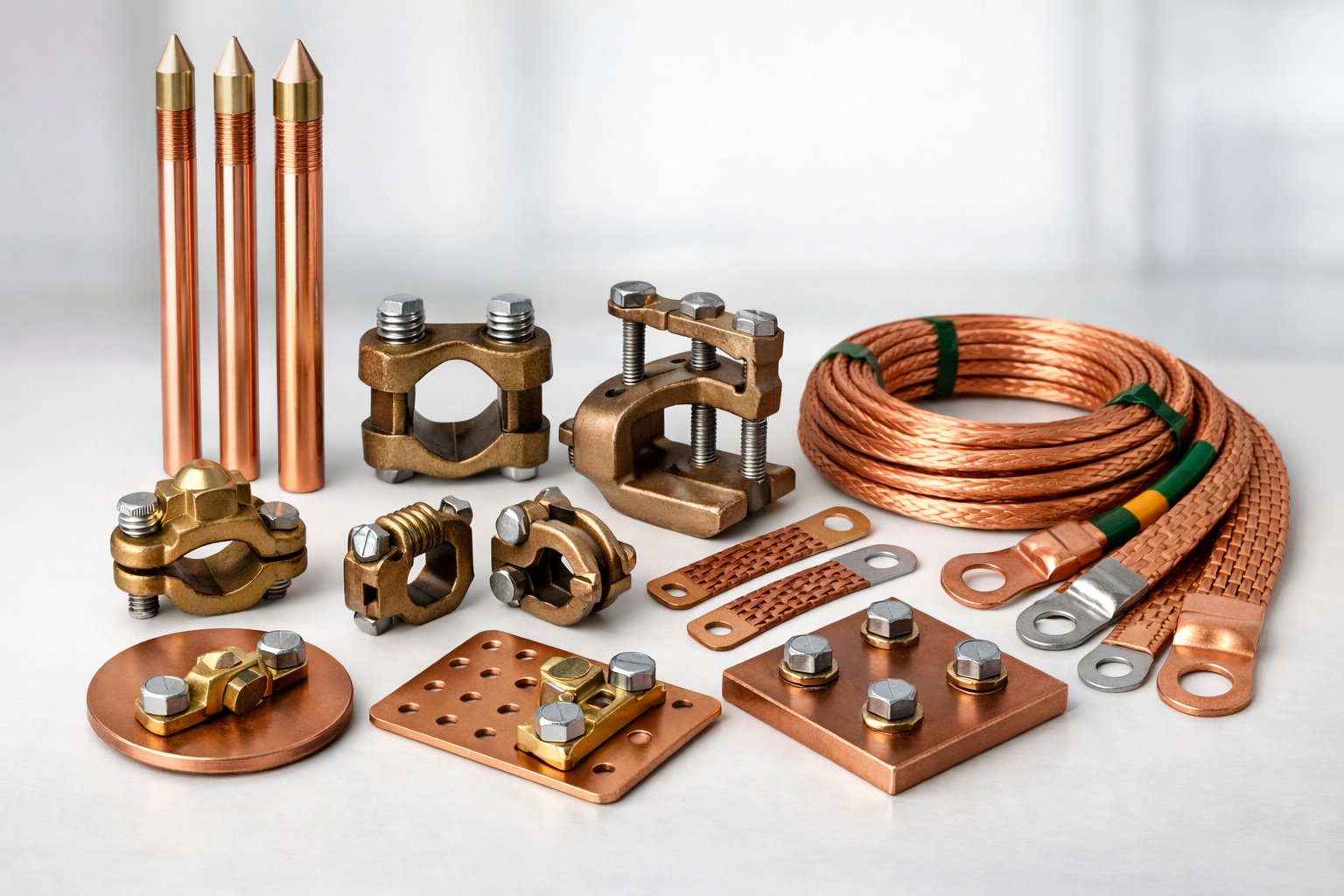
A solid grounding system is built from a mix of specialized products—ground rods, clamps, connectors, busbars, and bonding hardware—that all play a role in keeping your system safe and electrically sound. Each component has a job, whether it’s making that first earth contact or holding together all the connections inside a combiner box. If you’re in the field or designing systems, you need to know what each one does and how they fit together. It’s not just about code—it’s about real-world reliability.
Let’s dig into the grounding products you’ll actually encounter on the job, what makes them different, how they fit into your overall protection plan, and what you should be looking for when you’re choosing hardware for a project.
Overview of Electrical Grounding Products
Electrical grounding products are there to give fault currents a safe exit route and to establish solid voltage references across your system. There’s a surprising range—from classic copper-bonded rods you hammer into the dirt to specialty gear for equipotential planes in data centers.
Types of Grounding Products
Ground rods are your bread-and-butter grounding product. Usually copper-bonded steel or sometimes solid copper, you’ll drive these into the ground to hit a decent earth potential. If you’re dealing with rocky or sandy soil, ground plates might be the way to go—they give you more contact area when rods just aren’t practical.
Some of the most common grounding and bonding products you’ll see include:
- Ground bars and bus bars for centralizing all those ground wires in one spot
- Signal reference grids—essential for keeping noise down around sensitive electronics
- Ground enhancement materials to drop soil resistivity around your electrodes
- Grounding mats and mesh for covering large areas (think substation yards)
- Inspection housings so you can actually check your ground connections later on
- Aircraft and static grounding setups for those niche jobs
Custom ground bars are a real time-saver in big panels—just land all your grounding conductors there and you’re good. Brands like nVent ERICO and Burndy have both off-the-shelf and custom solutions, which is handy if you’re dealing with oddball layouts.
Potential equalization clamps are another must-have, especially for bonding together bits of metalwork—think rooftop solar racking—so you don’t get nasty voltage differences during a fault or lightning strike.
Key Features and Material Properties
Conductivity is king here. Copper’s the gold standard (well, copper standard?), but copper-bonded steel is a good compromise if you’re watching costs and still want decent performance. Aluminum’s out there, but honestly, I try to avoid it for grounding unless there’s a compelling reason.
Corrosion resistance can’t be ignored—especially if you’re working in wet, salty, or otherwise nasty soils. Stainless, hot-dipped galvanized, copper… pick what’s going to last. Industrial sites with contaminated soil? You’ll want to go all-in on corrosion-proof materials.
Mechanical strength is a practical concern. Ground rods have to survive being pounded into the earth, and ground bars need to handle a bunch of terminations without flexing. Don’t forget about your connection hardware—if those clamps or lugs loosen up or corrode, your whole ground path is compromised.
Importance of Grounding and Bonding
Grounding is what keeps people safe. It gives fault current somewhere to go, tripping breakers or fuses before anyone gets shocked. If you skip proper grounding, metal enclosures or solar racking can stay live after an insulation failure—nobody wants to find out the hard way.
Bonding is about tying all exposed metal together so you don’t get dangerous voltage differences. We bond enclosures, conduit, racking, and even structural steel to the ground system. That way, if something goes wrong, everything rises to the same potential and there’s no stray voltage waiting to bite someone.
Lightning protection really depends on a solid grounding and bonding network. The last thing you want is a lightning strike finding a weak point in your system. Signal reference grids keep noise and interference down in places like server rooms or control panels—honestly, it’s not just about lightning, it’s about clean signals too.
Detailed Guide to Major Grounding Components
A well-designed grounding system relies on a handful of key hardware pieces, all working together to create a safe, low-impedance path to earth. Let’s break down the main components you’ll actually use—from ground rods to connectors and everything in between.
Ground Rods and Rod Types
Ground rods get driven vertically into the earth to make that crucial electrical contact. Most of what you’ll see is copper-bonded steel—strong enough to drive, with the conductivity of copper on the outside. If you’re on a tight budget, galvanized rods are an option, but they just don’t perform as well as copper.
You’ll usually be looking at 8- or 10-foot rods, 5/8″ or 3/4″ diameter. Local code and soil conditions dictate how many and how deep. In bad soil, you might need to drive multiple rods, spaced at least six feet apart, or go deeper to hit moist, lower-resistivity layers. Stainless steel rods get the nod for extremely corrosive environments—think chemical plants or coastal installs.
Rod selection comes down to soil resistivity and expected fault current. If you’re dealing with rocky ground, sectional rods that screw together make life way easier. Sometimes, it’s all about getting deep enough to find soil that actually conducts.
Grounding Clamps and Connectors
Clamps and connectors are your workhorses for tying everything together. A good ground clamp—usually bronze or copper alloy—will bite down on the rod and conductor, keeping resistance low for decades. Corrosion resistance is a must; you don’t want to be digging these up every few years.
There’s a clamp for every situation. Acorn clamps are the go-to for direct burial. Lay-in lugs save time in tight spots. Mechanical connectors are great for quick installs, but make sure you size them properly to the conductor and rod. Everything should meet UL 467 if you want to pass inspection and sleep at night.
When installing grounding clamps, prep your surfaces—scrape off oxidation, add joint compound if it’s called for. Split-bolt connectors are handy for splicing multiple conductors, and irreversible compression sleeves are the gold standard for permanent, high-reliability installs.
Compression and Exothermic Grounding Methods
Compression grounding uses hydraulic tools to crimp sleeves onto your conductors and ground rods. Done right, you’ll get a gas-tight, vibration-proof connection that’s not going anywhere. Just make sure you’re using the right die for the sleeve size—otherwise, you’re asking for trouble.
Exothermic welding (Cadweld, HyGround, etc.) is a different beast. You’re basically creating a molten copper weld at the connection point. The result? A molecular bond that won’t loosen, corrode, or increase in resistance over time. It’s the go-to for lightning protection and utility work—anywhere you need absolute reliability.
For big commercial or industrial jobs, compression is usually faster and easier to scale. But when you want a “set it and forget it” connection, especially for critical systems, exothermic is tough to beat. Both options outperform standard mechanical connectors in terms of ampacity and long-term stability.
Specialized Grounding Materials and Accessories
Ground enhancement material (GEM) is a game-changer when you’re dealing with high-resistivity soil. If you’ve ever tried to hit spec in rocky or sandy ground, you know the struggle—native earth just doesn’t always cut it for low-resistance grounding. GEM, these conductive compounds we use, wrap around ground rods or electrodes and really help pull down the system resistance. It’s pretty cool that they can actually pull moisture out of the air, so even in dry spells when the soil’s bone-dry, your grounding grid stays effective.
We run into situations all the time—telecom sites, lightning protection setups, or just anywhere you can’t sink a bunch of extra rods because of space or rock. That’s where GEM comes in handy. It usually arrives as a powder or granular mix; you just add water and backfill it around the electrode. Some versions even have corrosion inhibitors mixed in, which is a nice touch for extending electrode lifespan, especially in aggressive soil.
There are some other accessories that make life easier in the field, too. Test wells let you check ground resistance on the fly, no need to disconnect anything. Insulated supports keep your conductors where they should be, and warning tape is essential for marking buried grounding runs—no surprises for future crews. And when you hit shallow bedrock, copper-bonded ground plates can be a solid alternative to standard rods. Each of these tools solves a specific headache, and honestly, they all help keep the electrical integrity of the grounding system intact.


